Your Cart is Empty



BY SERIES
BY TYPE
UPHOLSTERY

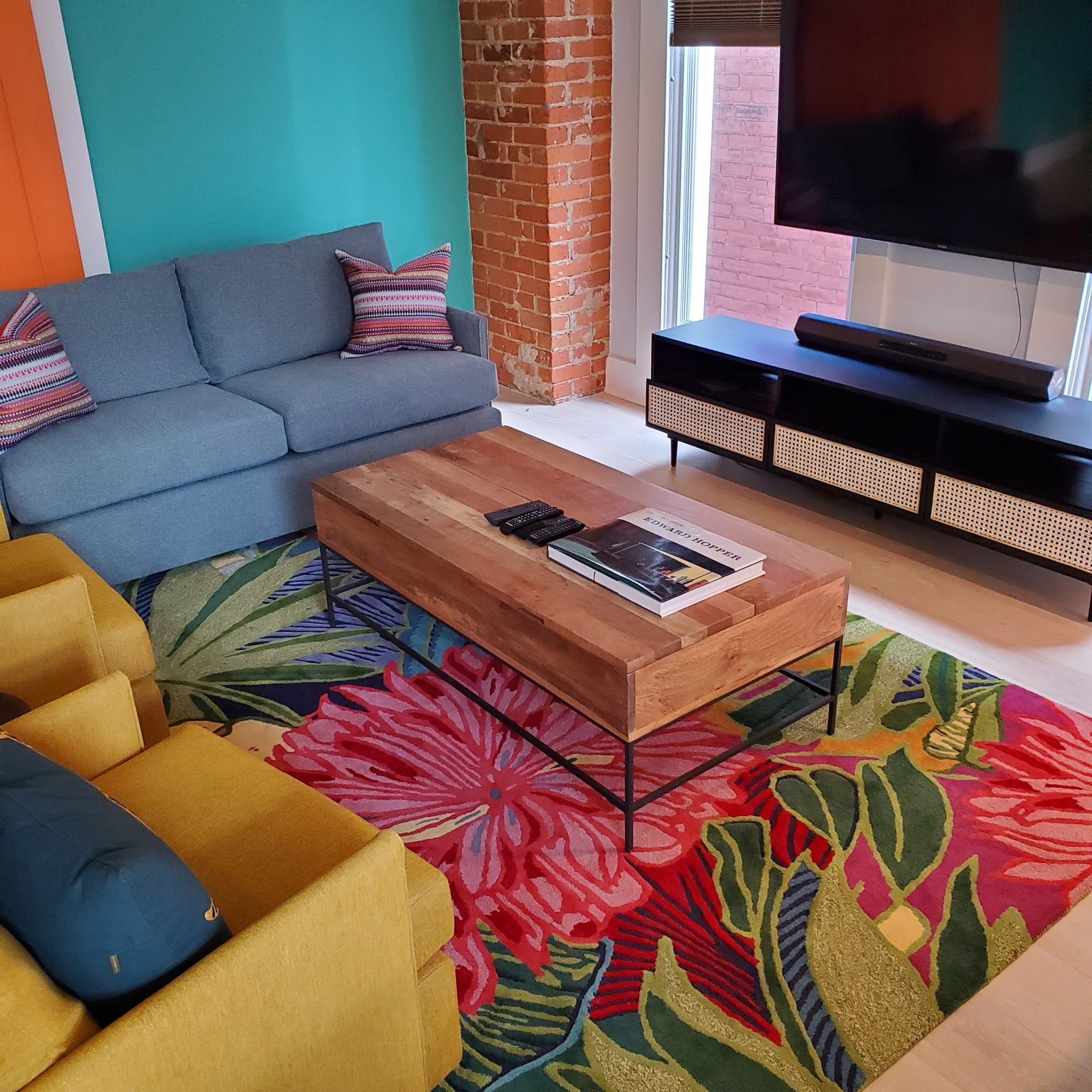
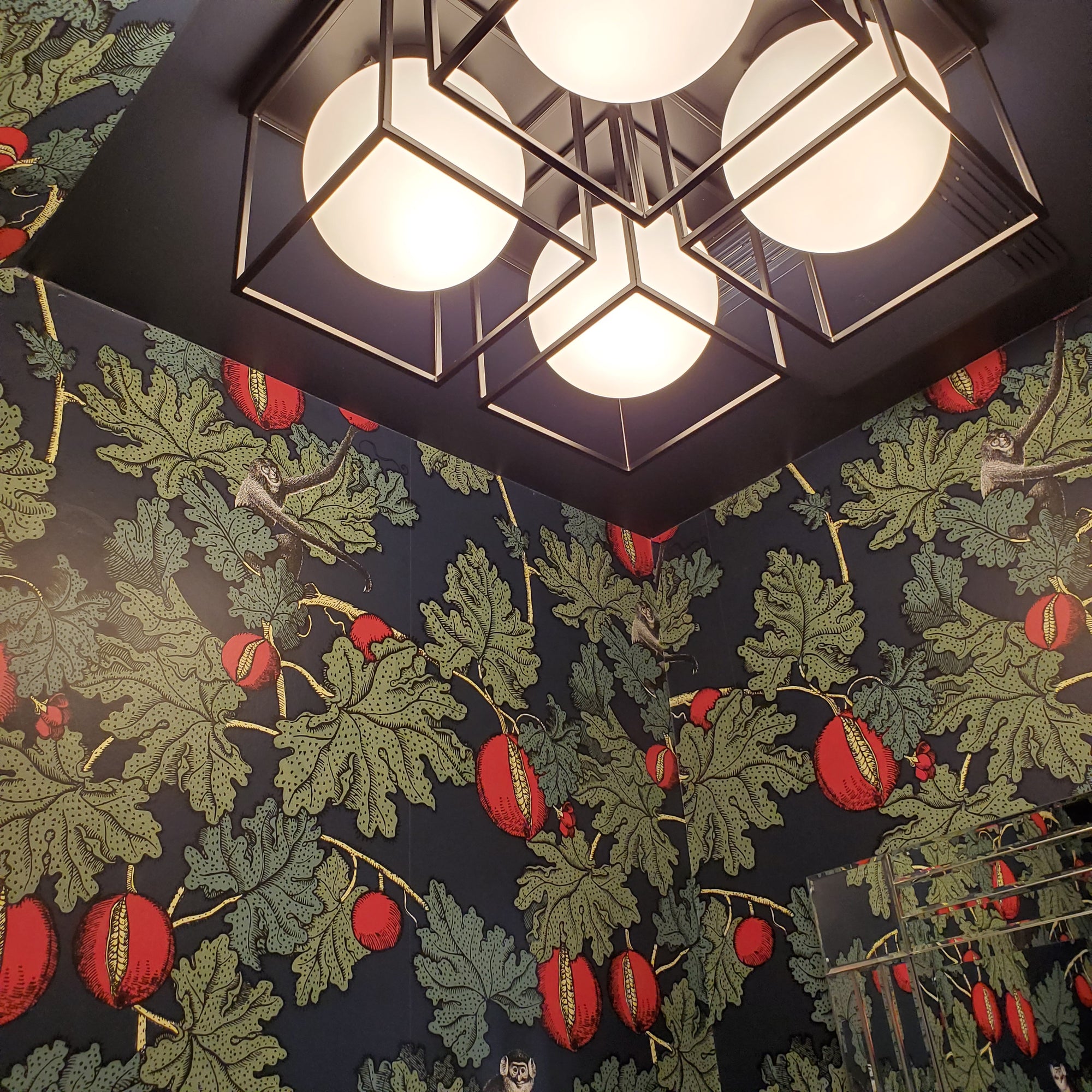
WALLPAPER & MURALS
RUGS & VINYL MATS
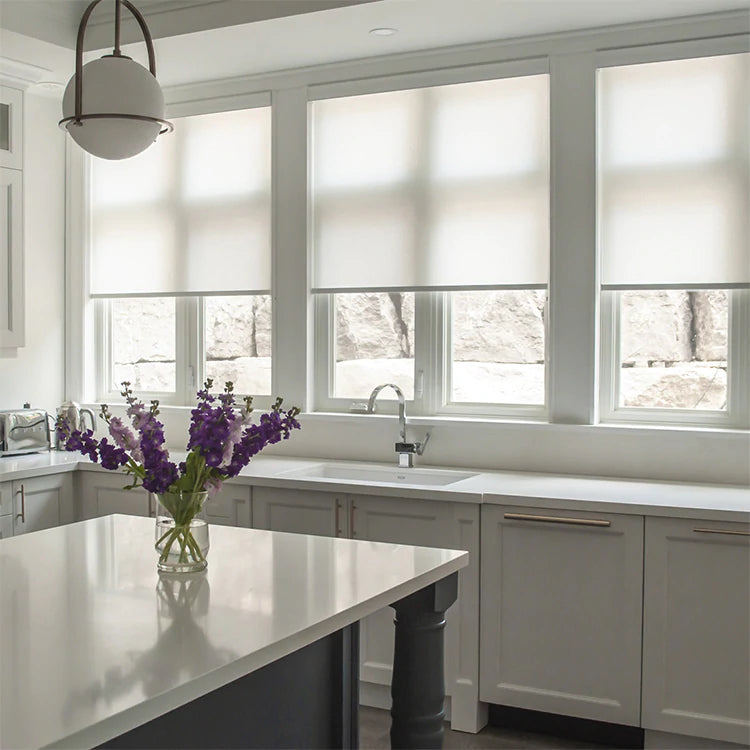
WINDOW SHADES
CUSTOM DRAPERY
TEXTILES & FABRICS
OUR PERSPECTIVE
OUR PROCESS
OUR PROJECTS


OUR STORY
FAQ & PROCESSES
CONTACT US
SHIPPING & RETURN POLICY

Last Updated: August 31, 2026
Wallpaper adds visual information that paint cannot: it creates depth, movement, and focal points that reshape how we perceive a space. Paint is a surface treatment; wallpaper is a design decision. According to the Colour and Vision Research Laboratory's findings on color perception, the human visual system responds strongly to pattern and contrast when judging spatial depth, which is why directional designs, light-reflecting colors, and carefully scaled motifs can genuinely alter how large or intimate a room feels.
At KENDALL & Co, we've been advising clients on bold interiors since 1998. The question we hear most from homeowners with compact spaces is whether wallpaper will make things feel cramped. The answer, almost always, is the opposite, provided you understand a few key principles.
Color temperature is the most underestimated tool in small-room design. Warm tones like soft terracottas and blush pinks create coziness; cool tones in soft pastels and muted blues push walls back visually, creating an airy atmosphere. Small-scale motifs, delicate florals, fine geometrics, subtle textures, keep visual weight low while delivering personality. Large-scale patterns work beautifully on a single accent wall but overwhelm when applied to all four walls.
Vertical lines draw the eye upward, making low ceilings feel taller. A room with 2.4-metre ceilings can feel significantly more generous with the right directional design than the same room painted in solid neutral.
The biggest mistake is picking a pattern you love at full scale without accounting for how it reads in a confined space. What looks dramatic on a showroom roll can feel relentless when it surrounds you on three walls of a 3-by-3-metre bedroom.
The rule of thumb: the smaller the room, the more intentional your pattern selection needs to be. This doesn't mean defaulting to the smallest motif, it means understanding the relationship between room proportions and visual weight.
| Pattern Type | Best For | Visual Effect | Caution |
|---|---|---|---|
| Small-scale motifs | All four walls, small rooms | Adds texture without visual clutter | Can read as "busy" in dark colorways |
| Large-scale patterns | Single accent wall only | Creates drama and focal point | Overwhelming on multiple walls |
| Vertical stripes | Low-ceiling rooms | Increases perceived ceiling height | Avoid very wide stripes in narrow rooms |
| Geometric patterns | Modern, structured spaces | Adds spatial movement | Bold geometrics need breathing room |
| Directional designs | Rooms needing expansion | Guides eye along desired axis | Direction must align with longest wall |
Small-scale motifs are the reliable workhorse of compact room design, allowing you to wallpaper all four walls without visual closure. Choose a motif with enough contrast to register from across the room, too faint disappears, too dense creates clutter.
Large-scale patterns work as a single focal point. One wall covered in an oversized botanical or bold geometric becomes something the eye moves toward. The remaining three walls should be quieter: a complementary solid, a matte tone pulled from the pattern, or fine texture that recedes.
Vertical lines create visual expansion upward; horizontal lines push walls apart laterally. Choose direction based on the room's weakness: low ceiling or narrow width. Fine pinstripes and soft tonal stripes achieve spatial movement with more elegance than bold, high-contrast stripes, which can distort proportions.
The accent wall delivers maximum visual impact with minimum commitment. A single wallpapered wall immediately creates a focal point, making the room feel more considered and spacious rather than smaller.
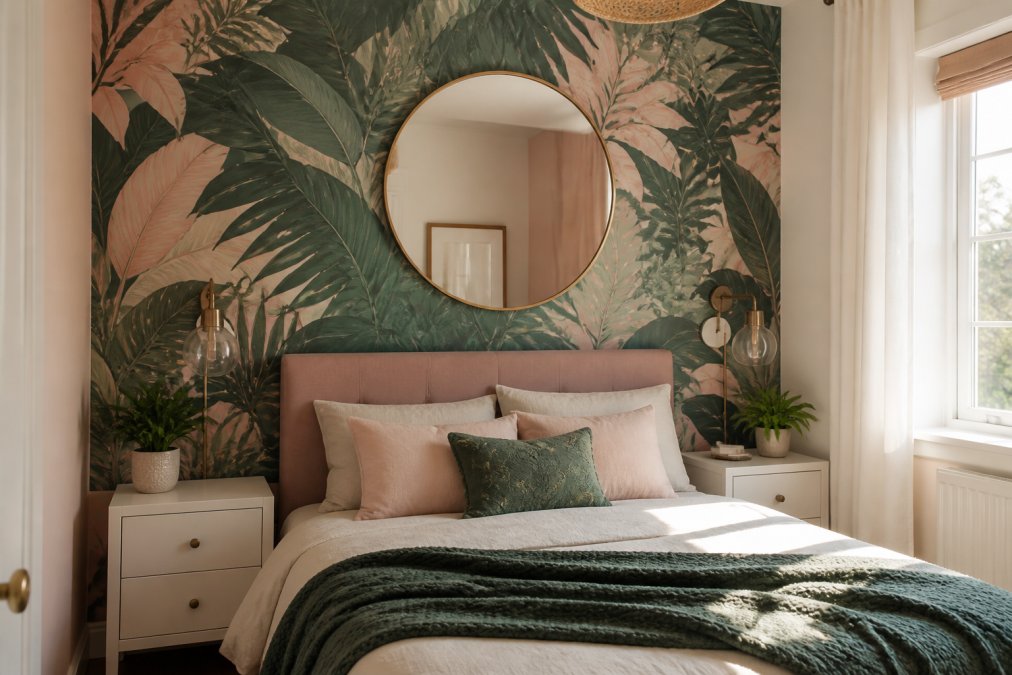
The most effective accent walls align with furniture arrangement. The wall behind the bed is the natural choice because it's where the eye enters the room. Complement it with a large mirror on an adjacent wall to double visual depth and bounce light around the space.
Wallpapering behind the bed is the single most impactful design decision in a small bedroom. Extend the pattern floor to ceiling rather than stopping at headboard height to maintain vertical line and avoid awkward visual breaks. Choose a pattern with enough visual weight to hold its own against the bed, but not so dominant that it competes.
Neutral palettes with textural interest, grasscloth, linen-look papers, soft geometric weaves, work particularly well because they add depth without chromatic intensity. If you want color, ground it in mid-tones: deep teal, warm terracotta, forest green.
Light-reflecting colors perform very differently under natural versus artificial light. A wallpaper luminous in cool daylight can appear flat under warm incandescent bulbs. Always test a sample in the room at multiple times of day before committing.
Metallic accents in wallpaper actively reflect light, creating spatial movement as light sources change throughout the day. This works best in rooms with at least one natural light source. According to the Illuminating Engineering Society's guidance on residential lighting, light layering, combining ambient, task, and accent sources, significantly affects how surface colors and textures are perceived. For wallpapered small rooms, adding a wall sconce or picture light near the accent wall enhances both pattern and depth.
Measuring wallpaper for small rooms requires precision. Here is the standard process:
A common mistake is calculating square metres without accounting for pattern repeat waste. On wallpaper with a 64 cm repeat, you can lose 30-40 cm per panel to matching. Always calculate by drops, not by raw area.
Heavy wallpaper, natural fibre weaves, grasscloth, thick vinyl-backed papers, requires more preparation than standard paper. Poor surface prep or wrong adhesive results in peeling edges, bubbling, or drywall damage upon removal.
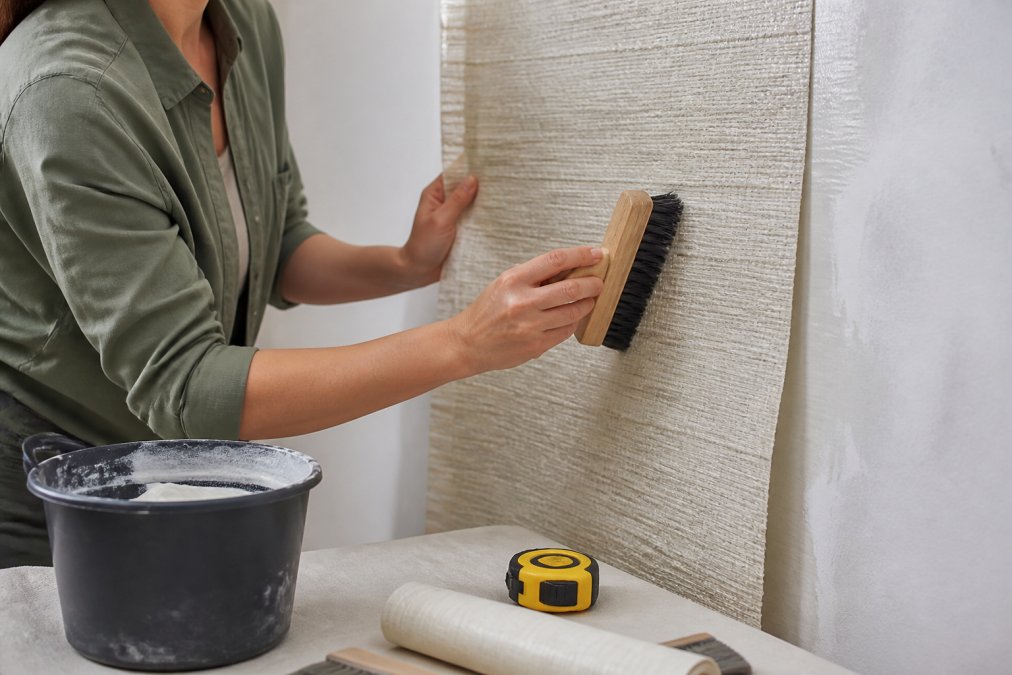
Drywall is not a stable substrate for heavy wallpaper unless properly sealed. Unpainted or poorly primed drywall is porous and absorbs moisture from adhesive unevenly, causing inconsistent bonding and destructive removal. As documented in the Canadian Construction Materials Centre's guidelines on interior finishes, proper substrate preparation is the most critical factor in the long-term performance of applied wall finishes.
Surface preparation for heavy wallpaper follows a non-negotiable sequence:
Heavy papers require high-solids, heavy-duty wallpaper paste rather than standard pre-mixed adhesive. Grasscloth and natural fibre weaves need paste that remains workable for 10-15 minutes. Avoid adhesives with high water content for natural fibre papers, as moisture causes uneven expansion and permanent tide marks.
The most effective budget-friendly approach is to paper only the accent wall, reducing material cost significantly while achieving the same focal-point effect. For a standard 3.6-metre-wide bedroom wall, you'll typically need three to four drops, often achievable from two standard rolls.
Other practical hacks: use peel-and-stick wallpaper for renters or flexible spaces; paper the ceiling instead of walls for a dramatically different effect; repurpose leftover wallpaper as drawer liners, bookshelf backing, or framed art panels.
For maintenance, most modern wallpapers are wipeable or washable, but natural fibre papers are neither. Grasscloth and sisal papers should never be cleaned with water, spot-clean only with a dry cloth. For high-traffic areas like hallways or bathrooms, choose vinyl-coated or scrubbable paper instead.
Choosing wallpaper for small rooms is one of the most rewarding design decisions you can make. The wrong pattern scale, an unprimed wall, or a mismatch between paper weight and adhesive can undermine an otherwise beautiful choice. The KENDALL & Co design studio in Cabbagetown houses thousands of wall-coverings, and our team offers personalized appointments to help you navigate pattern scale, color temperature, and installation requirements for your specific space. Click Here to Shop and book a consultation with our team.
Light-reflecting colors, neutral palettes, and vertical stripe patterns are the most effective at creating visual expansion in a small room. Soft pastels, off-whites, and cool-toned hues make walls recede, giving the impression of more space. Small-scale geometric patterns and designs with strong vertical lines draw the eye upward, increasing the perceived ceiling height. A matte finish reduces visual clutter, while strategic metallic accents add depth without overwhelming the room proportions.
Wallpapering all four walls works well with very light colors, subtle textures, or small-scale motifs that don't overwhelm the space. For bolder or large-scale patterns, choosing a single accent wall, such as the wall behind the bed in a bedroom, creates a focal point without adding visual weight to the entire room. A single wallpapered wall paired with complementary paint on the remaining three walls is a popular approach that balances impact with an airy atmosphere.
Avoid oversized, high-contrast patterns that compete for attention across a small surface area, as they can make walls feel closer together rather than farther apart. Very dark backgrounds with large-scale motifs add visual weight and reduce the sense of depth perception. Busy, all-over prints with no clear directional design can also create visual clutter. Horizontal stripes, while useful for widening a narrow room, can lower a ceiling's apparent height if used on all four walls without careful planning.
Wallpaper is firmly back as a leading interior design choice. Wall murals, textured grasscloth, and bold geometric patterns are among the most requested finishes for residential and commercial spaces alike. The shift toward personalized, story-driven interiors has made wallpaper one of the most effective tools for adding character to a room that paint alone cannot achieve. Choosing wallpaper for small rooms specifically has grown in popularity as designers demonstrate how the right pattern and color temperature can transform a tight space.
Comments will be approved before showing up.